
Steritherm VLA
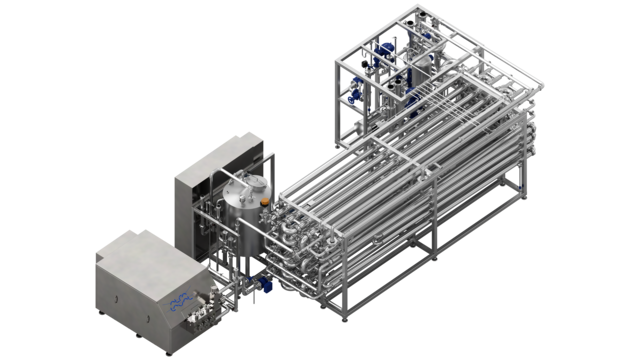
Augmentez la stabilité microbiologique des produits alimentaires à viscosité moyenne à élevée en éliminant ou en inactivant les micro-organismes. Le Steritherm VLA est un système de traitement aseptique basé sur un échangeur de chaleur tubulaire à traitement thermique doux et uniforme. Polyvalent et robuste, ce stérilisateur aseptique maximise le temps de fonctionnement et minimise la maintenance.

Stérilisateur tubulaire monté sur skid pour les produits fibreux, particulaires ou visqueux
- Plus grande flexibilité de production pour les produits à haute viscosité et ceux contenant des fibres et des particules
- Traitement polyvalent de différentes capacités et formulations de produits
- Traitement en douceur avec chauffage et refroidissement uniformes
- Fonctionnement fiable et peu coûteux avec des durées longues grâce à une efficacité de transfert thermique supérieure
- Fonctionnement quasi sans entretien grâce à l'absence de pièces mobiles et à de faibles besoins en maintenance
Stérilisez des produits de viscosité moyenne à élevée, avec ou sans particules, à l'aide de l'Alfa Laval Steritherm VLA.
Polyvalent et robuste, ce stérilisateur tubulaire aseptique est équipé d'un échangeur de chaleur annulaire Alfa Laval Viscoline. Il combine une température élevée et un temps de maintien pour une stérilisation efficace afin de garantir la sécurité des produits tout au long du processus d'emballage.
La livraison, l'installation, le fonctionnement et la maintenance sont rapides et faciles. Des modèles spéciaux sont disponibles pour :
- l'élimination de l'air du produit avant le traitement grâce à l'intégration du module de désaération Alfa Alrox
- la récupération indirecte de la chaleur pour améliorer l'efficacité énergétique
- le fonctionnement dans des conditions de haute pression pour les produits à haute viscosité tels que les purées, les confitures, les soupes avec particules et les produits à base de tomates
How the aseptic sterilizer works during continuous thermal processing
The Steritherm VLA uses the Viscoline VLA-4 annular tube heat exchanger, in which the product flows between two concentric pipes, each surrounded by heating or cooling media. The media flows in a direction counter-current to the product flow through corresponding annular gaps between the outer product pipe and the shell pipe, and between the inner product pipe and the pipe in the centre. The use of corrugated pipe surfaces improves heat transfer efficiency between the media and product.
Superheated water at 125 °C (257°F) pre-sterilizes the Steritherm VLA for 30 minutes before allowing any product to flow into the unit. The product enters the balance tank, and a pump transfers it to the first heater, where circulating hot water raises the product to the required sterilization temperature. It then passes through a tubular holding cell for the necessary residence time for effective treatment.
Cooling the product occurs in two stages – first with tower water, then chilled water – before entering the aseptic filler tank. If the temperature falls below the set point, a diversion function prevents any untreated product from reaching the filler.
The product is cooled in two stages – by tower water and then by chilled water – before it enters the aseptic filler tank. Should the heat treatment temperature drop below a pre-set value, a diversion function ensures no untreated product reaches the filler. The arrangement enables production to restart after attaining the correct temperature without requiring re-sterilisation with water for high-acid products with a pH of 4.5 or higher.
Other versions include indirect heat recovery, combination with an Alfa Laval Alrox deaerator module and, in case of very highly products, special high-pressure designs.
Aseptic sterilization
Aseptic sterilizer flow chart
Products



Food system services
Alfa Laval Food system services help extend the performance of your food systems by maximizing the performance of your processes. This enables you to:
- Continually improve your operations to maintain competitive advantage
- Focus on uptime, optimization and availability
- Maximize return on investment throughout the life cycle of your food systems
Learn more about our service offer for food systems
