Commercial Brewing Equipment: What Breweries Need for Efficient Production
In commercial brewing, efficiency begins and ends with the quality of the equipment. And what was considered efficient and cutting-edge a decade ago in commercial beer making equipment might not be making the grade now.
And just as a chain is only as strong as its weakest link, so a commercial brewer is only as efficient as the most inefficient stage of the production process.
That means brewers need to be forever seeking out the very latest in commercial beer brewing equipment and technologies, and accessing the best in beer-making expertise, to ensure they are keeping ahead of their competitors.
By operating at their most efficient, they boost the profitability and sustainability of their operations. And having this bedrock of efficiency then allows brewers the security to dedicate time towards experimenting with their product lines to tackle the challenges of shifting consumer tastes.
Efficiency in heat transfer
If commercial brewers are going to reach their efficiency goals they need to get it right in the brewhouse and Alfa Laval’s heat transfer expertise ensures maximum efficiency when it comes to wort heating.
Take, for example, its T25 gasketed plate heat exchanger (GPHE), which operates as a vapour condenser in the brewhouse, recycling hot water produced from wort vapour and using it to pre-heat the next wort batch.
Compared to a traditional shell and tube solution, the GPHE technology can boost the efficiency of operations by increasing the temperature of the heating water at this key point in the process from around 95°C to 99°C.
It means less steam is required to get the wort to the boiling point at the next stage in the process, and it means the total steam consumption of wort pre-heating and boiling can be reduced by around 10%.
That boost in efficiency means less water and energy used, not to mention reduced CO2 emissions, which saves on costs and boosts sustainability. Indeed, any water that can be saved in the water-intensive brewing process is worth its weight in gold, especially for those brewers operating in water-stressed regions where strict regulations are likely to be in place.
When it comes to considering the efficiency of equipment, it is also important to consider the hygiene requirements, as this can also be resource-heavy in terms of water and chemicals.
With the GPHE technology, the units are easy to clean in place, which ensures minimized downtime, and the thermal performance is maintained at a very high level.
The unit is also unusually compact with a much smaller space footprint than its shell and tube equivalent, so this, combined with its superior performance, is an example of Alfa Laval’s innovative commercial brewing equipment efficiency in action.
Separator efficiency
Minimizing the extract losses during the separation process and ensuring the maximum amount of material can be recovered and reused is at the heart of ensuring efficiency in commercial brewing.
Alfa Laval has always been at the forefront when it comes to integrating the efficiency benefits of separation into the beer-making process. Over the last couple of decades, decanters and high-speed separators have been fully embraced by commercial brewers as the competitive advantages they have brought to large-scale production have shone through.
The complete range of Alfa Laval’s separation portfolio means that it can work with customers to ensure that it can match the ideal equipment for the specific application, whether it is pre-clarification, green beer separation, hot wort separation or beer recovery, to ensure maximized efficiency in operations.
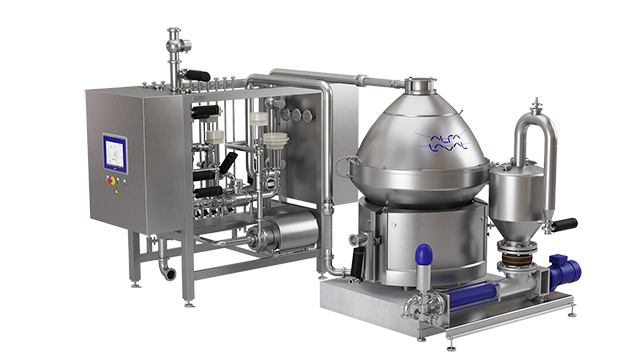
The disc-stack separators in the Brew series, for instance, have been delivering for some of the biggest names in beer-making for decades and continue to be refined and improved to meet the increasing demand of the moment.
Indeed, one look at the names of the centrifuges in the Brew series range tells the story of how it can support the smallest brewers to smoothly scale-up so that operations can reach an industrial level with no sacrifice in operational efficiency or product quality.
Starting with the Brew20, the various models can support the needs of all shapes and sizes of breweries, until we meet the Brew750e, which does the separation business for some of the largest beer operations in the world.
But no matter what the size of operations, when it comes to efficiency in brewing separation, oxygen is the enemy. For optimum performance, brewers need to minimize its impact on their separation processes, and the Brew series’ pioneering approach, with its hermetic design, ensures that there is a near-zero oxygen pick-up in the process.
From these strong foundations, the Brew high-speed separators deliver extremely smooth and gentle handling in the bowl, which ensures consistency and quality, opens the door to diversification, and delivers energy savings as high as 60% compared with traditional separators.
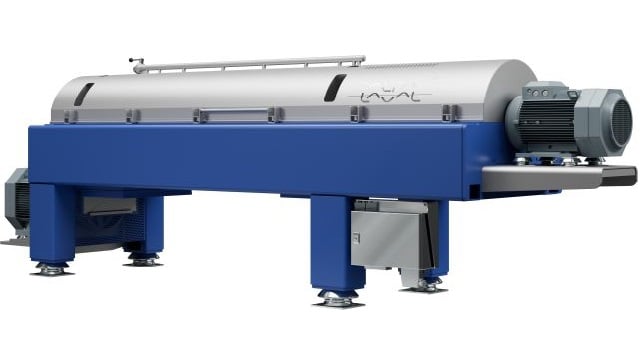
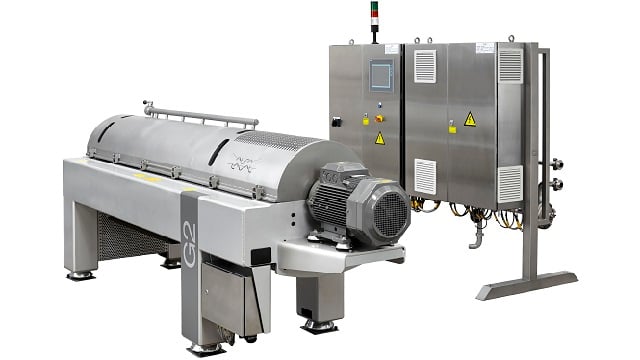
Meanwhile, Alfa Laval’s Foodec decanters can also work with Alfa Laval’s Intelligent Whirlpool System (IWS) to deliver unparalleled efficiency when preparing the wort.
The IWS is designed for larger brew sizes and has a shorter whirlpool time by up to 20%, improving wort yield and wort quality, while reducing water consumption and increasing operational speed. It enables higher hop utilization by separating residual solids in the decanter, minimizes fouling and clogging in the wort cooler and reduces volumes of trub (the sediment of inactive yeast and other debris) in the fermentation.
Any recovered wort is returned to the same brew, while trub waste can be treated and turned into valuable byproducts such as biofuel or animal feed.
Pushing the boundaries of performance
What commercial brewers need from their expert partners when it comes to efficient separation is a flair for innovation and out-of-the-box thinking, and a commitment to pushing the boundaries of performance.
That’s what Alfa Laval has delivered in the eMotion, a unique energy-saving module available as an add-on to the Brew series.
The module has a vacuum pump connected to the separator that removes air outside, reducing friction between the bowl and the casing. With reduced friction, the separator bowl rotates with less resistance, reducing energy consumption, bowl temperature, cleaning requirements and noise levels, which can boost the original 60% energy savings to up to 75%.
Meanwhile, the UniDisc technology in the Brew series is an industry-leading component that is a key part of taking process efficiency to even greater heights.
Unlike traditional separator discs with caulks (disc spacers) welded to the plate, the discs with UniDisc technology have micro caulks molded from the metal plate itself during the form-pressing process.
Having these micro caulks means that the designers could increase the number of discs in the disc stack, so increasing the surface area and boosting separation performance by 30% against traditional components.
The bigger the Brew series model, the greater the surface area and the higher the performance boost, and with its higher capacity, consistent even flow of process liquid through the stack, and cost-effective cleanability, it is another great example of precision Alfa Laval technology delivering major efficiency benefits for commercial brewers.
Equipment that supports sustainable brewing
Operating efficiency not only means profitability; it means sustainability. In a water- and energy- hungry process, any commercial brewing equipment that cuts resource-use is contributing to the planet as well as to the bottom line.
Equipment like Alfa Laval’s groundbreaking Optiwia module, developed over the last five years, can deliver significant efficiency improvements, specifically around water, that most precious of commodities for the brewer.
In fact, by recirculating water streams used in the separation process into a collecting tank ready for cooling deployment, Optiwia saves up to 70% on water use in the clarifying separators, reducing the costs of use and disposal, improving efficiency, and supporting sustainable brewing.
You might expect technology that delivers such outstanding results to be a sizeable piece of kit, but in fact, Optiwia is a robust, compact plug-and-play unit that can be retrofitted if required.
It adjusts for changes in water pressure to ensure the centrifuge operates smoothly and maintains consistent uptime, and what makes this system truly unique is that no cooling agent or kilowatt-demanding air-liquid chiller is needed.
It is similar innovative thinking, rooted in an in-depth knowledge of brewing operations, that has seen the development of ProCarb Inline Carbonation, which can be added to selected centrifuges to deliver high-quality, efficient carbonation at a fraction of the time traditionally required, and, in doing so, boosts productivity and reduces oxygen pick-up.
Precise mixing
Inefficient yeast management can have serious repercussions for commercial brewers throughout the process, so ensuring they secure equipment that delivers precise mixing is vital for overall production efficiency.
They need robust, reliable and effective equipment that will meet the challenges of operating at scale to deliver consistently high-quality yeast control that will save on water and energy in the cold block, especially in the fermentation and maturation phases.
Alfa Laval’s Iso-Mix rotary jet system, for instance, is just one such example, keeping the yeast evenly mixed with wort and ensuring faster and more effective fermentation and maturation processes, while optimizing temperature control.
This is yet another area of expertise for Alfa Laval, as its world-class product portfolio of rotary jet heads can offer solutions for challenges such as foaming, process inconsistency, subpar hygiene, lengthy sedimentation time, beer loss and excess yeast.
Control, cleaning, maintenance and monitoring
Equipment that ensures systems are working at their optimum level has become essential for commercial brewing efficiency.
Alfa Laval is leading the way in this regard, with a portfolio of innovative and integrated solutions that ensure systems are joined up and working to maximum effect.
Its Tank Top plate system, for example, is used around the world by commercial brewers to control the tank top pressure, protect against uncontrolled overpressure or vacuum, and compensate for the change in liquid volume during filling and emptying with gas.
Meanwhile, effective and sustainable cleaning is, of course, an imperative when it comes to overall operating efficiency for commercial brewers.
This is an industry that cleans its equipment on a frequent basis to ensure product safety and quality, as well as opening the door to diversification and producing different products, so any technology that can conserve water can have a significant impact.
Alfa Laval’s CIP (cleaning in place) module is a modularised skid-mounted plug-in station for automated cleaning-in-place procedures for brewery equipment such as piping, tanks, filling machines, heat exchangers, and other units. The cleaning regime is fully adjustable in terms of cleaning time, temperature, pressure and flow to ensure the best results.
And when it comes to monitoring, Alfa Laval’s ConditionAlert offers a complete, real-time view of any separator’s health and performance. This is an advanced condition monitoring system that continuously tracks key operating parameters and provides early warnings when attention is needed.
It delivers accurate insights to prevent unplanned downtime and boost efficiency, and, combined with expert analysis from Alfa Laval, it ensures optimal separator performance, reliability, and longevity.
Efficiency and future proofing
Brewing is a simple process, but when it is upscaled to industrial size, there is a level of complexity that requires a commercial brewer to look to an expert partner with an understanding of the sector that is both broad and deep.
The most advanced equipment needs to be complemented by specialist oversight that can analyze and tweak operations to ensure the very best in efficiency, which in turn leads to optimum sustainability and profitability.
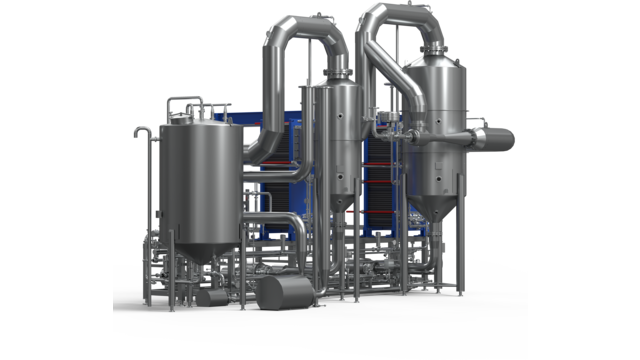
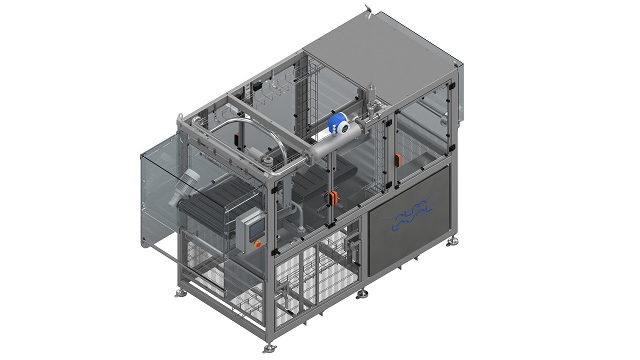
Developments have moved at a pace, and future technologies not yet imagined will inevitably be on their way to join recent innovations such as Alfa Laval’s REVOS system, which concentrates beer at the brewery for rehydration elsewhere, saving water, energy and CO2 emissions in the process without impacting quality.
This could well be the road to efficiency that all commercial brewers follow as a matter of course in the near future, but whatever direction that journey takes, Alfa Laval will be on hand with a roadmap to direct customers to the most efficient solutions.