
2022-10-04 Product news
$175 Million District Energy Investment in Richmond, B.C.
The financing will allow for more than 170 new residential and mixed-use commercial development sites in the Richmond, B.C. area by 2050.
This article is related to Canada’s commercial HVAC industry. Alfa Laval provides energy-saving compact plate heat exchangers to many commercial premises, industrial facilities and public buildings in Canada.
View the full article on foodincanada.com
“…The Canada Infrastructure Bank (CIB), Lulu Island Energy Company (LIEC) and Corix Infrastructure Inc. (Corix) have closed on a district energy expansion project in Richmond, British Columbia.
Under the agreement, the CIB will provide $175 million in financing for the LIEC City Centre District Energy Utility project. It will enable expansion to more than 170 new residential and mixed-use commercial development sites in the area by 2050, using low-carbon heat recovered from the Gilbert Road regional sewer system.
When complete, the project is expected to reduce greenhouse gas emissions by one million tonnes by 2050, with the amount of connected space to the district energy system increasing 10–fold to 50 million square feet...”
Click here to learn more about Alfa Laval’s heat exchangers for the cooling and heating of air and water in buildings.
Tags
All
A thorough makeover – including boilers, pipes, heat exchangers and substations – of the district heating system within a residential area in the Ukrainian city of Odessa turned out to be somewhat of a model case. A modern 3-circuit solution with a primary side comprising the distribution network produced considerable energy savings – and thereby a very encouraging example.
Good relations and reliable technology
The system replaced was of traditional design, tormented by the “classical” problems of high water flows, excessive hot water tapping and inflexible heat supply. The system put into place is a modern 3-circuit solution, where the circuits for production, distribution and end-user consumptions are separated. The primary side comprises the distribution network all the way to the consumer substation.
The project included transition from three central district heating substations to 36 individual substations, equipped with 40 heat and hot water heat exchangers produced by Alfa Laval. In this project, Alfa Laval assumed the role of advisor, coordination of installations and main equipment supplier.
The customer for this comprehensive project was a municipal development company Odessateploenergo, that has been an Alfa Laval customer for more than three years. The chairman of the company, mr Valery N. Pyatov explains why Alfa Laval was a natural choice:
Well, first of all we have a very solid relationship with them. We have worked with them for a couple of years by now. For this project, they offered attractive technological solutions that have been tested in Sweden and in other parts of the world with excellent result. We put real emphasis on the reliability of the technology, and we are very satisfied."
During the project, the Alfa Laval team devised efficient routines for close interaction with the companies Logstor (pipe provider) and Petrokraft (renovation and replacement of burners including controls). In fact, this enterprise was more than a renovation project. It was in fact replacement of obsolete equipment with a completely new system, although built upon well-proven solutions for the various functions.
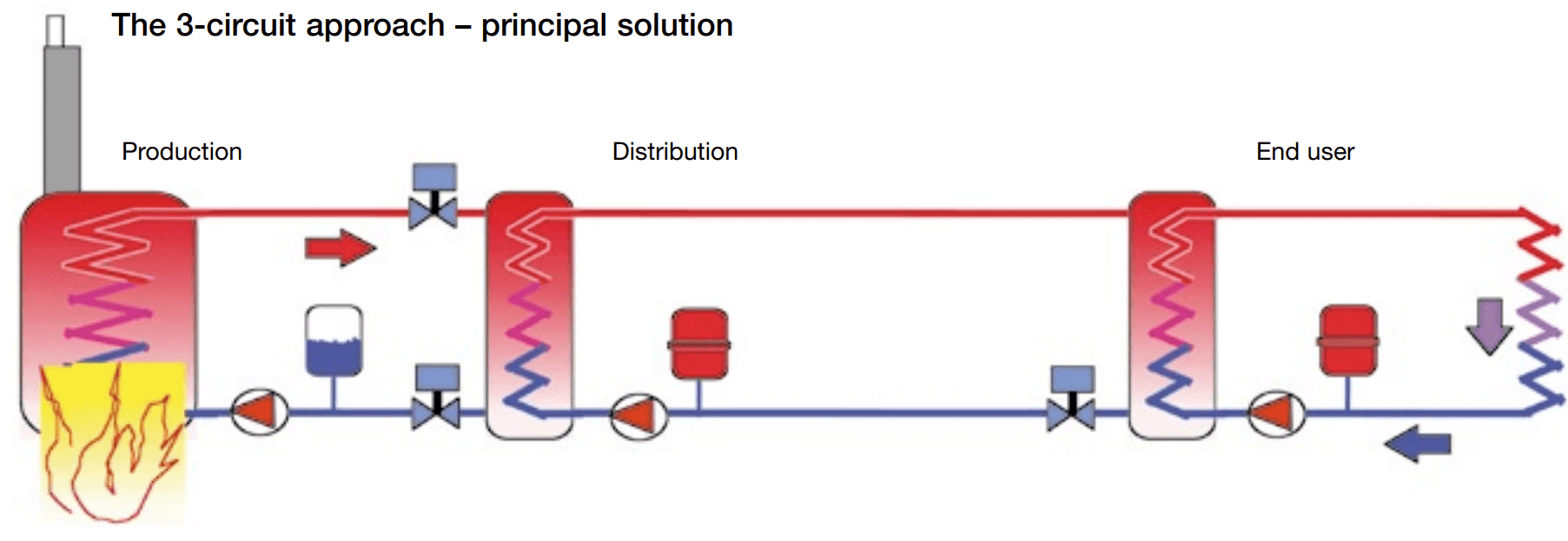
A primary distribution circuit
The production unit of the 3-circuit system consists of hot water along with heat exchangers, condensers, circulation pumps, water treatment equipment and instruments for supervision and control. Hot water (130°C) is used as a medium to carry the energy.
The distribution circuit between the production unit and the consumer substation is on the primary side, a fact implying a fair set of advantages. The temperature and pressure level can be kept relatively low. Since the temperature difference is larger, a high effect can be obtained with relatively modest flows. Consequently, pipe dimensions can be reduced. In turn, this means reduced energy consumption by pumps. This type of distribution network can be supported from different production units and is easily linked to looped networks in order to add capacity or ensure a stable heat supply.
On the secondary (consumer) side, substations ensure the supply of heat and eliminate some of the problems stemming from excessive tapping. Hot tap water is produced locally in every substation and the total energy consumption can be measured at one point. Water transmission due to tapping will be restricted to the consumer circuit.
Short payback horizon and considerable energy savings
From previous experience, the payback interval for this kind of project can be expected to be fairly short – i.e. due to the considerable energy savings achieved by the application of state-of-the-art (still well documented) equipment. In fact, the energy consumption in this case was no less than 35% as an annual average. The consumption of water from the district heating network was reduced 30 times (from 34 277 m3 down to 1 225 m3).