
Refroidisseurs d'air hybrides - HYAC
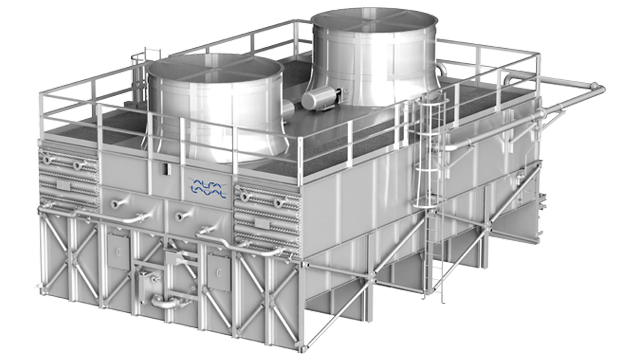
Combinant le refroidissement par air traditionnel et le refroidissement par évaporation en boucle fermée, les refroidisseurs d’air hybrides Alfa Laval (HYAC) offrent un refroidissement fiable et efficace pour une gamme d’applications industrielles. HYAC Alfa Laval tire parti des possibilités de refroidissement offertes par la nature.

Hautes performances, empreinte environnementale légère
- Entièrement adapté à vos conditions et exigences de fonctionnement
- Équipement robuste, de qualité industrielle, aux performances exceptionnelles dans le temps
- Performances de refroidissement exceptionnelles et consommation d’eau minimale
- Taille compacte, permettant d’augmenter la capacité de refroidissement même lorsque l’espace disponible est limité
- Faible consommation d'énergie
Les systèmes Alfa Laval HYAC offrent un concept de refroidissement compact et durable pour les installations nécessitant une capacité de refroidissement élevée et une faible consommation d’eau. Une conception robuste et simple garantit un fonctionnement stable pendant de nombreuses décennies et une maintenance minimale, avec un faible coût total de possession.
Ces systèmes sont idéaux pour le refroidissement de liquides et de gaz, ainsi que pour les tâches de condensation, notamment dans les industries suivantes : pétrole et gaz, raffinerie, produits pétrochimiques, acier, pâte à papier et papier, énergie thermique et énergie renouvelable.
Fully tailored to your requirements
All Alfa Laval HYAC systems are engineered to order and fully customized to fit your performance requirements and operating conditions perfectly, resulting in high return on investment.
- Materials – Tube bundles are available in traditional carbon steel, stainless steel, as well as in more exotic alloys and titanium in case of corrosive media.
- Equipment standards – If you have plant standards for different types of equipment, such as control systems, pumps, and valves, we are happy to build your HYAC system using your preferred brands.
- Multiple cooling loops – With a HYAC system you can cool several process media simultaneously in one unit by installing parallel tube bundles for the different media. This can have a very positive effect on CAPEX.
- Capacity – HYAC coolers are available in all sizes from small, skid-mounted units to large, field-erected systems.
Optimize water usage, maximize cooling
All Alfa Laval hybrid heat exchanger systems are engineered to order and fully customized to fit your performance requirements and operating conditions perfectly.
Alfa Laval HYAC is available in two different models: Single Zone (SZ) and Dual Zone (DZ).
Unique features of hybrid air-coolers
Alfa Laval HYAC Single Zone (SZ)
The Single Zone model is intended for installations where temperature fluctuations in the ambient air cause insufficient cooling in traditional air-cooled heat exchangers.
An Alfa Laval HYAC solves the problem by switching between two operating modes: dry cooling and wet cooling, depending on the ambient temperature.
By only engaging the wet cooling mode when required, during hotter periods, both water consumption and installation space is minimized, while ensuring correct output temperatures.
Alfa Laval HYAC Dual Zone (DZ)
The Dual Zone model is used in plants where increased cooling capacity is required, e.g. when expanding production capacity. The first cooling zone in a HYAC DZ operates as a traditional air-cooled heat exchanger and the second zone as an evaporative cooler.
Thanks to the second zone, the cooling capacity per installed area is significantly higher if compared to a traditional air-cooled heat exchanger system, yet with a much lower water consumption than a cooling tower.
The design with two cooling zones allows for hotter process inlet temperatures and simultaneously provides plume mitigation on the evaporative cooling zone.
Working principle of HYAC SZ
An Alfa Laval HYAC SZ has one cooling zone. When the ambient temperature is low, the HYAC system operates as a traditional air-cooled heat exchanger; the hot medium flows through a bundle of finned tubes, and a fan draws cool air over the tube surfaces to cool the medium inside.
When the ambient temperature rises above a certain level, wet cooling mode is activated, and water is sprayed on the tubes. The heat from the hot medium evaporates the water on the tube surfaces, which increases cooling significantly.
Since wet cooling only is engaged when required, substantial amounts of water is saved compared to a cooling tower solution. And compared to an air-cooled heat exchanger, a HYAC system is much smaller and has fewer fans, saving both CAPEX and OPEX.
Working principle of HYAC DZ
An Alfa Laval HYAC DZ has two cooling zones. The first is a traditional air-cooled heat exchanger, and the second is an evaporative cooler, very similar to a standard Alfa Laval WSAC.
During normal operation, both zones are always engaged. The hot medium is first cooled in the air-cooler zone, approaching the dry bulb temperature, and is then further cooled in the second zone, reaching a final temperature close to the wet bulb temperature.
This two-stage cooling results in a much higher cooling capacity and lower output temperature than for traditional air-cooled heat exchangers. It also saves water compared to standard evaporative cooling systems and cooling towers. In addition, the dual zone design also leads to less visible plume.
This makes Alfa Laval HYAC systems the perfect solution for expansions where increased cooling and low water consumption are required and where space is limited. Thanks to its high cooling efficiency, a HYAC system is much smaller than a comparable air-cooler solution, resulting in lower CAPEX and OPEX.

Packaged systems
- Compact, skidded, pre-piped and pre-wired units
- Control cabinet and water treatment section available
- Factory tested
- Plug-and-play systems, fast and easy installation
- Freeze protection available
- Typical heat duties per unit up to 10 MMBTU/h (2.9 MW)
Modular systems
- Medium-sized systems, ideal for expansions
- Prefabricated modules assembled on site
- Casings made of heavy-gauge steel
- Factory tested
- Freeze protection available
- Typical heat duties per unit from 10 MMBTU/h to over 30 MMBTU/h (2.9 - 8.8 MW)
Field-erected systems
- Large systems with minimal footprint
- Concrete basin with overlying structure made of fibre-reinforced plastics (FRP) or concrete
- Lowest installed cost and total cost of ownership for high-capacity cooling/condensing
- Interchangeable modules
- Freeze protection available
- Large cooling loads
Choose an Alfa Laval HYAC Single Zone hybrid heat exchanger if you:
- Have highly fluctuating ambient temperatures that approach or exceed the desired process outlet temperature
- Experience insufficient process cooling during hot periods
- Wish to save water during periods with lower ambient temperatures
Choose an Alfa Laval HYAC Dual Zone hybrid heat exchanger if you:
- Have fairly high ambient dry-bulb temperatures
- Experience insufficient process cooling in your plant or will see benefit from even lower outlet temperatures
- Wish to save water
- Have hot inlet temps and when plume abatement is desired

Choose an Alfa Laval WSAC wet surface air cooler if you have:
- Good access to water
- Insufficient cooling capacity in your plant
- Process benefits from lower outlet temperatures, such as increased production capacity, or lower operating costs

Choose an Alfa Laval ACE air-cooled heat exchanger if you have:
- No access to water
3 hybrid air-cooler configurations
Alfa Laval HYAC systems are available in three different configurations with different capacity spans. All three configurations can be used for cooling fluids and gases, as well as condensing
Choose the right solution
Not sure which air-cooled heat exchanger is the right solution for you? Let us guide you through the different options.

Discover how our wide range of hybrid air-cooler services can help you increase operating reliability, reduce water and energy consumption, maximize performance and keep maintenance costs low.
Our service engineers are ready to assist you throughout the entire lifecycle of your equipment. They can help with installation and commissioning, regular maintenance, performance audits, troubleshooting, upgrades and training to name a few examples.