Type 2
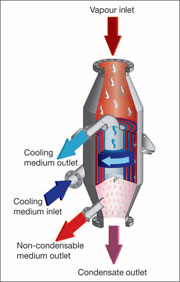
L'échangeur de chaleur spiralé Alfa Laval Type 2 est utilisé pour les applications à 2 phases, à la fois condensation et évaporation (rebouillage). Dans cette configuration, la spirale est toujours en position verticale. Condensation à écoulement transversal avec la perte de charge la plus faible possible.

Dans cette configuration, l’échangeur thermique spiralé est toujours en position verticale. La compacité des échangeurs de chaleur spiralés Alfa Laval Type 2 et le fait qu'ils soient montés verticalement permettent de les installer sur un espace très limité par rapport aux unités tubulaires équivalentes. En outre, ils réduisent les structures d'appui et la complexité des tuyauteries.
L'échangeur de chaleur spiralé Alfa Laval Type 2 est en « cross-flow » (débit tangentiel) plutôt qu'en écoulement à contre-courant. Du fait du bon intervalle entre les canaux du côté condensation, la perte de charge est généralement très faible dans le circuit de condensation. Ce type convient donc de manière idéale aux applications de condensation sous vide.
Applications:
- Gaz: vapeur pure et mélanges avec gaz inertes.
- Vapeur/liquide: Condenseurs de tête, condenseurs à reflux, condenseurs sous vide, condenseurs d'aération, rebouilleurs pour fluides encrassants et refroidisseurs de gaz.
Fonctionnement
Operating principles
The OTS Type 2 spiral heat exchanger features a single-channel design, which means that each fluid occupies a single channel. This enables one medium to move in a spiral flow while the other moves in a cross flow, parallel to the axis of the spiral element. The spiral-flow channel is welded shut on each side, whereas the other medium passes through the open spiral element. This design combines high liquid velocity
in the closed spiral with large flow volume and low pressure drop on the cross-flow vapour side.
Self-cleaning
The single-channel construction eliminates bypassing and reduces fouling. The turbulence of the fluid in the channel constantly flushes away any scaling or deposits as soon as they form. If fouling occurs, thus diminishing the cross section of the channel, the velocity increases and scrubs away deposits at the exact zone affected.